
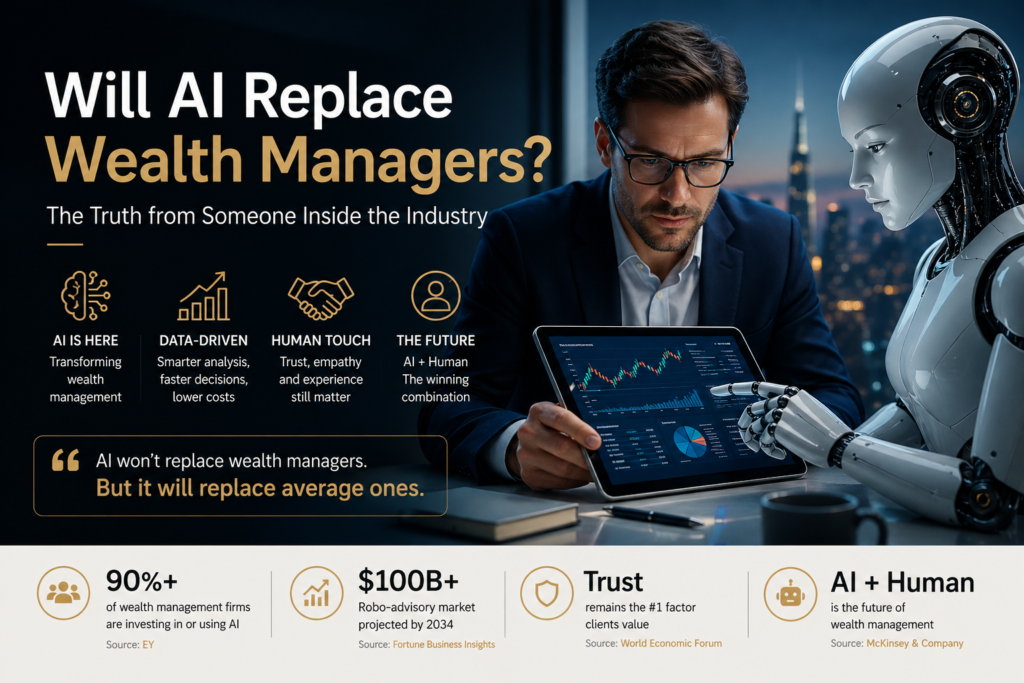
Over the last few years, one question has quietly taken over conversations in finance:
“Will AI replace wealth managers?”
At first glance, it feels obvious.
AI is getting smarter.
Automation is getting cheaper.
And investing is becoming more accessible than ever.
But after spending years inside wealth management, working closely with clients and seeing how decisions are actually made, I can tell you this:
AI will not replace wealth managers.
But it will fundamentally change who survives in this industry.
The Reality: AI Is Already Transforming Wealth Management
This is not a future trend. It is already happening at scale.
According to EY:
- Over 90% of wealth and asset management firms are already investing in or using AI in some capacity
- Generative AI adoption is accelerating across client servicing, research, and operations
Similarly, research from McKinsey & Company highlights that:
- AI can automate up to 40–60% of tasks in financial advisory workflows
- The biggest gains are in productivity, cost reduction, and scalability
The World Economic Forum also notes that:
- AI-driven tools are rapidly reshaping how retail investors access advice
- Trust, however, remains the biggest barrier to full automation
This is important.
Technology is moving fast
But human behavior is not
What AI Is Already Replacing (And Doing Better)
Let’s be honest — AI is already better than most wealth managers in several areas.
1. Data Processing at Scale
AI can:
- Analyze thousands of securities instantly
- Track macroeconomic indicators in real time
- Identify correlations that humans would miss
This is not a small improvement.
This is a complete shift in capability.
2. Portfolio Construction
Robo-advisory platforms today can:
- Build diversified portfolios in seconds
- Automatically rebalance
- Optimize for risk and return
And they do it at a fraction of the cost.
According to industry comparisons:
- Traditional advisors: ~1% fee
- Robo-advisors: ~0.25% fee
This difference is massive over long periods.
3. Execution Without Emotion
AI does not:
- Panic during crashes
- Chase trends
- Get influenced by noise
It follows rules.
And in investing, discipline often beats intelligence.
4. Cost Efficiency
Lower cost is one of the biggest disruptors.
As platforms scale, the marginal cost of advice approaches zero.
Which leads to a dangerous question for the industry:
“If AI can do this cheaper, why do I need a human?”
The Rise of Robo-Advisors: A Structural Shift
The growth of robo-advisors is not hype — it is measurable.
Reports indicate:
- The robo-advisory market is expected to exceed $100 billion in assets under management in the coming decade
- Adoption among younger investors is rising rapidly
- Digital-first investors prefer speed, transparency, and low cost
This signals a generational shift.
Younger clients are comfortable trusting platforms — not people.
The Behavioral Gap: Where AI Still Falls Short
This is where theory meets reality.
1. Fear During Market Crashes
In every downturn, clients don’t behave like models.
They:
- Panic
- Sell at the worst time
- Question long-term strategies
AI can recommend “stay invested.”
But it cannot:
Sit across the table
Understand fear
Build confidence
2. Greed During Bull Markets
When markets go up:
- Clients want more risk
- They chase performance
- They ignore downside
Again, AI can warn.
But it cannot control behavior.
3. Complex Human Context
Every client is different.
- Family responsibilities
- Cultural mindset
- Income stability
- Life stage
AI can model scenarios.
But it struggles with:
Nuance
Emotion
Personal priorities
Trust: The Real Currency of Wealth Management
his is the most underestimated factor.
Clients don’t just invest money.
They invest:
- Trust
- Confidence
- Belief in decision-making
Even industry discussions (including those highlighted by World Economic Forum) emphasize:
AI adoption is high
But trust in fully automated advice is still limited
And trust is not built through algorithms.
It is built through:
- Conversations
- Consistency
- Experience
The Real Disruption: Not Replacement, But Compression
Here is the uncomfortable truth:
AI will not eliminate wealth managers.
It will compress the industry.
What does that mean?
- Fewer people will be needed
- Average advisors will struggle
- Top advisors will become more valuable
Who Will Be Replaced?
Let’s be direct.
If your value is:
- Basic portfolio allocation
- Generic advice
- Selling standard products
Then yes — AI will replace you.
Because:
AI does it faster
AI does it cheaper
AI does it better
Who Will Survive (And Thrive)?
The future wealth manager will look very different.
They will not compete with AI.
They will use it.
The New Role: Decision Architect
Instead of:
Stock picker
Product seller
They become:
Decision coach
Behavioral guide
Strategic advisor
The Skill Shift
Future success will depend on:
- Understanding psychology
- Simplifying complexity
- Communicating clearly
- Building long-term trust
Because information is no longer scarce.
Clarity is.
The Hybrid Model: Human + AI
Every major report converges on the same conclusion:
The future is hybrid
- AI handles:
- Data
- analysis
- execution
- Humans handle:
- trust
- judgment
- behavior
This is not competition.
This is collaboration.
What This Means for Clients
Clients will benefit significantly:
- Lower costs
- Better tools
- More transparency
- Faster decisions
But they will still need guidance.
Because:
The biggest mistakes in investing are emotional, not analytical
My Personal View (From Inside the Industry)
After years in wealth management, I’ve realized something simple:
The hardest part of investing is not knowing what to do.
It is actually doing it consistently.
AI solves the first problem.
Humans are still needed for the second.
Final Thought
AI will not replace wealth managers.
But it will force the industry to evolve faster than ever before.
The real divide will not be:
Human vs AI
It will be:
Adapted vs outdated
If you are a wealth manager:
Learn to use AI
If you are a client:
Ask better questions
Because the future of wealth management is not about technology alone.
It is about how humans use it.
Yes Ai is the next big thing